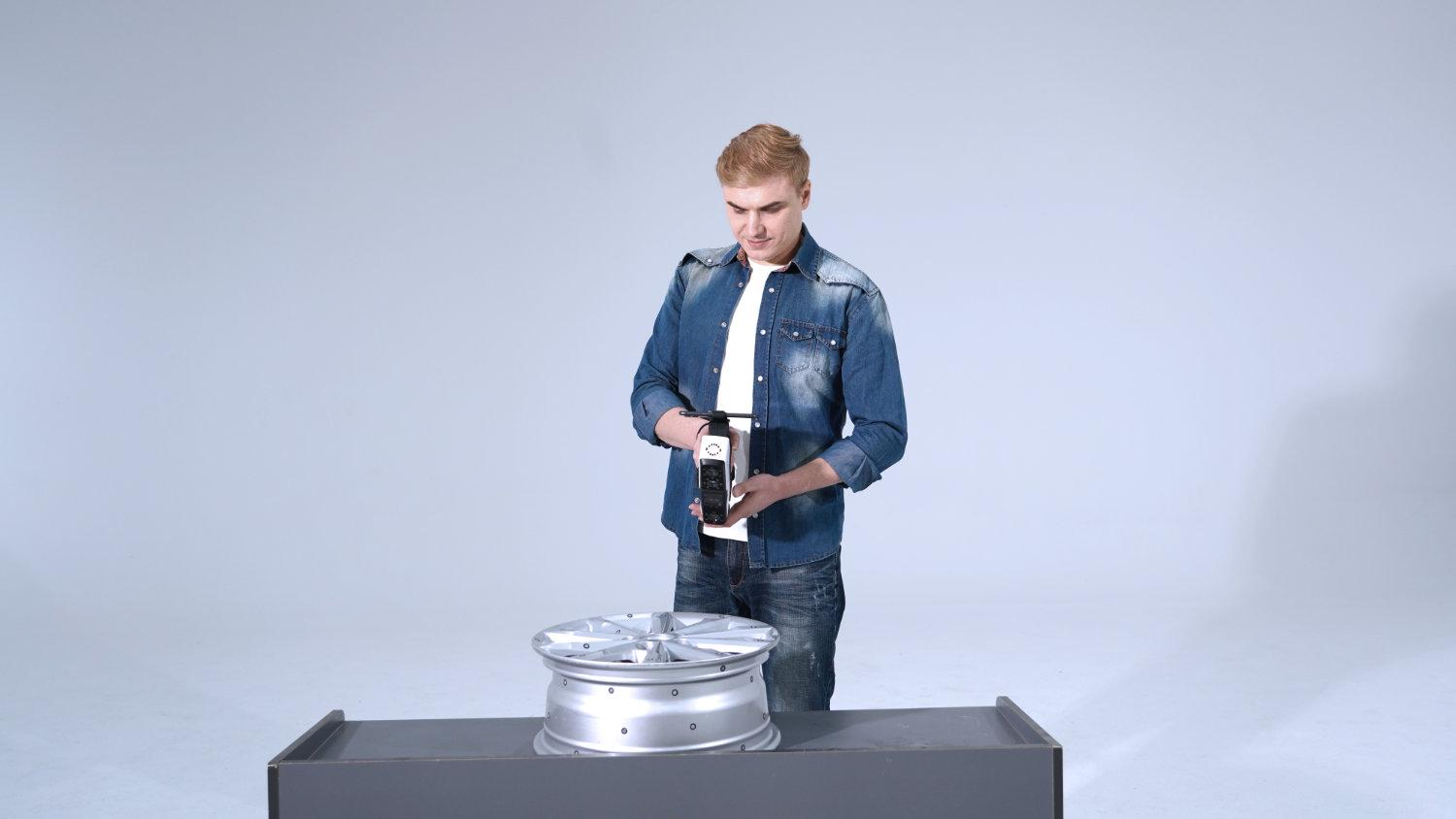
In an era defined by digital transformation, the need to bridge the physical and digital worlds has never been more critical. Accurate dimensional data is the foundation of precise digital work, whether for reverse engineering complex components, preserving historical artifacts, or creating custom medical devices. The 3D scanner has emerged as a vital tool across numerous advanced industries in response to this demand.
A 3D scanner is a non-contact, non-destructive device designed to capture the shape—and often the color and texture—of physical objects or environments. It collects geometric and surface details from its surroundings, converting this information into a digital 3D mesh or point cloud. This digital model can then be measured, analyzed, modified, simulated, or reproduced with remarkable accuracy. Understanding the underlying technology and real-world applications of 3D scanners is essential for businesses seeking to enhance operational efficiency and drive innovation.
Core Technology: How 3D Scanners Work
Although methods such as laser triangulation and structured light differ in execution, all modern 3D scanners share a common objective: rapidly capturing millions of data points to form a point cloud.
A widely used approach involves projecting patterns of light—such as infrared speckles or blue laser lines—onto an object’s surface. Integrated cameras then observe how these patterns deform when they encounter the object’s shape. Using triangulation, the scanner’s software calculates the precise X, Y, and Z coordinates of each point based on the known spatial relationship between the projector and cameras.
Advanced scanners often combine multiple light sources or scanning modes to optimize results for different tasks. For instance, some systems employ blue laser lines for high-accuracy scanning of complex, reflective, or dark surfaces, while also using infrared speckle projection for larger or organic shapes without the need for markers. The resulting point cloud is processed into a clean, usable mesh model ready for analysis or modification in software, ensuring the digital twin is a faithful replica of the original object.
Handheld 3D Scanners: Merging Mobility with Precision
A major focus in the evolution of 3D scanning hardware has been improving ease of use and flexibility without sacrificing accuracy. This has established the handheld 3D scanner as the preferred tool for many professional applications. Unlike stationary tripod-based systems, handheld scanners offer superior flexibility, especially when objects are too large, inaccessible, or delicate to be moved.
Handheld systems utilize internal tracking and alignment algorithms to continuously monitor the scanner’s position relative to the object. Many modern professional scanners support “marker-free” operation on most surfaces, using hybrid alignment techniques that combine target markers with natural surface features. This dynamic tracking enables the operator to move freely around a subject—whether a person, vehicle, or machine—while data is seamlessly stitched together in real time.
Key benefits for industrial and B2B users include:
Portability: Scanning can be performed anywhere, from a factory floor to a remote site.
Speed and Efficiency: Rapid digitization of complex objects shortens product development and design cycles.
Versatility: Operators can easily transition between scanning large components and capturing fine details by adjusting scanning distance and trajectory.
These portable devices have become indispensable in professional digitization workflows, combining speed, adaptability, and high precision.
Business Applications: Expanding Possibilities
The data generated by 3D scanners plays a crucial role across numerous sectors, streamlining processes and unlocking new opportunities.
In reverse engineering, 3D scanning allows engineers to create a digital model from a physical part when original CAD data is unavailable. This model supports design recovery, replication, or improvement. In quality control and inspection, scanners compare as-built components against nominal CAD models with micrometer-level precision, ensuring products meet strict specifications before leaving the factory.
Beyond manufacturing, the technology is invaluable in cultural heritage and archaeology, where non-contact scanning preserves fragile artifacts without risk of damage. In medical rehabilitation and orthotics, patient-specific scans enable the custom fitting of prosthetics, braces, and surgical guides with unprecedented accuracy. Additionally, the virtual display and digital human industries rely on 3D scanning to supply high-quality, real-world data for creating realistic assets in gaming, VFX, and augmented reality (AR) applications.
Achieving Precision with 3DeVOK Solutions
Companies such as 3DeVOK develop hardware and software focused on speed, accuracy, and color fidelity to meet diverse professional 3D scanning needs.
The 3DeVOK MQ Color 3D Scanner, for example, is user-friendly and excels at high-quality color capture, making it ideal for digital human, art, and virtual display projects. It utilizes a 22-line infrared laser and infrared speckle projection to capture up to 4.5 million points per second, delivering efficiency for professional use. With an accuracy of up to 0.08 mm and a resolution of 0.1 mm, it faithfully reproduces both geometry and 24-bit true-color texture.
For more demanding industrial metrology tasks, the 3DeVOK MT Professional 3D Scanner offers enhanced performance. It employs a versatile three-light-source system—combining 34 blue laser lines, 22 infrared laser lines, and large-area infrared speckle—to achieve optimal results on challenging materials and sizes. With a base accuracy of up to 0.04 mm and resolution up to 0.05 mm, the MT scanner supports high-level quality control and reverse engineering. Its hybrid alignment capability and frequent marker-free operation simplify the scanning of large or complex objects.
By pairing advanced proprietary hardware with comprehensive software, 3DeVOK provides a complete ecosystem for transforming physical objects into reliable, actionable digital data—empowering professionals to maintain precision and foster innovation in their respective fields.
