Solar generation and electricity demand rarely follow the same timetable. Photovoltaic panels may produce their strongest output during daylight hours, while homes and small businesses can require substantial electricity later in the evening or during periods of weak sunlight. Solar battery storage addresses this timing gap by holding electricity until it is needed.
Within that broader category, a lead acid solar battery remains one possible choice because it combines relatively low initial cost with established compatibility across many solar-storage configurations. Its suitability, however, depends on more than purchase price.
Service life, efficiency, maintenance, operating conditions, system voltage, and expected cycling frequency all influence whether this battery type fits a particular project.
How Lead-Acid Storage Fits Into a Solar System
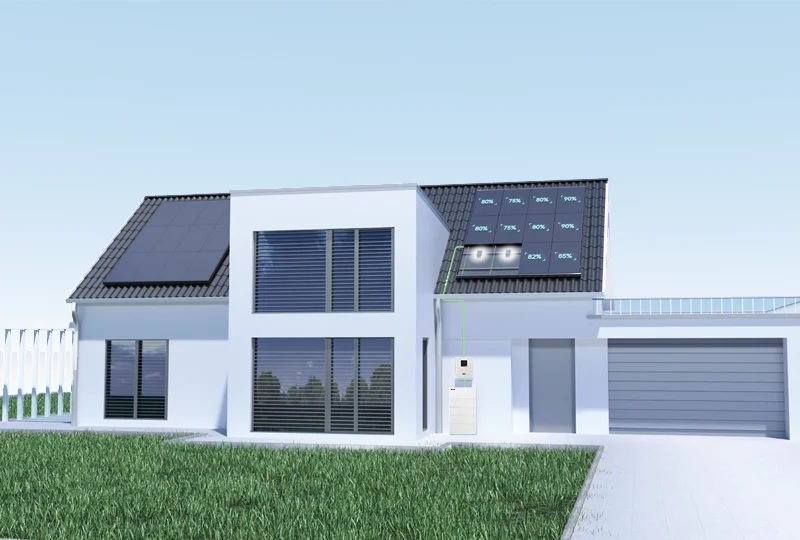
A battery does not operate as an isolated component in a photovoltaic installation. Solar panels produce electricity, a hybrid inverter manages power conversion and charging logic, and the battery bank stores part of the available energy for later discharge. In a solar battery storage configuration, daytime production can first serve active loads, while excess generation is directed toward the battery.
Stored electricity can then support loads after solar production falls, during periods of high demand, or when the utility grid becomes unavailable. That discharge role becomes most visible when solar production and load demand no longer coincide.
Charging does not have to depend entirely on photovoltaic generation. Systems can also use utility electricity during off-peak periods when the control strategy permits it. Depending on system priorities, operating logic may emphasize PV power, household load, or grid interaction. These choices affect how frequently the battery cycles and how much stored energy remains available for backup.
A lead acid solar battery can perform this storage role when the inverter supports the required battery type and voltage range. Compatibility therefore begins with the electrical platform rather than with battery capacity alone.
Benefits and Trade-Offs That Affect Real Use
The main attraction of lead-acid technology is its lower initial cost relative to many lithium-based alternatives. That characteristic can make it relevant for smaller installations where budget limitations carry considerable weight. Initial price, however, represents only one part of storage economics. Lead-acid batteries generally have shorter service life, lower efficiency, and greater maintenance requirements than lithium-based systems.
These differences become more significant when a battery is expected to charge and discharge frequently. A system used mainly for occasional backup may place different demands on the battery than one used every day for shifting solar energy into evening hours. As cycling frequency increases, service life and usable energy over time become increasingly important.
Solar battery storage should therefore be evaluated on the amount of energy that can be used repeatedly, not simply the nominal capacity printed on a specification sheet. Depth of discharge, conversion losses, expected cycle life, maintenance needs, and operating environment all contribute to the practical value of the system.
Sizing, Voltage and Compatibility Considerations
Storage capacity should be based on actual energy requirements. Daily electricity consumption provides a starting point, while required backup duration determines how long the system must continue supplying power without sufficient solar generation or grid input. Larger loads and longer autonomy naturally require more stored energy.
Voltage must also match the inverter platform. GSOpower‘s GST hybrid inverter series, for example, supports lithium, lead-acid, and user defined battery types on a 48 V rated battery platform with a listed operating range of 40–60 V.
That specification illustrates why a lead acid solar battery cannot be selected only by amp-hour rating. Battery voltage, charging method, inverter requirements, and communication or control settings all have to work together.
Expansion strategy deserves attention as well. A smaller initial installation may be adequate for current demand, but later load growth can change the required storage capacity. Modular configurations can reduce the need to oversize the first installation if the electrical design supports future expansion.
Where Lead-Acid Batteries Can Make Practical Sense
The strongest case for lead-acid technology generally appears where the project values lower upfront expenditure more heavily than long cycle life or maximum conversion efficiency. Smaller solar installations, occasional backup applications, and systems with moderate cycling requirements can therefore present different economics from heavily cycled residential or commercial storage projects.
A lead acid solar battery also needs an installation environment that matches its maintenance and operating requirements. System designers should consider ventilation, charging conditions, discharge depth, temperature, and accessibility before treating battery chemistry as a simple purchasing decision. A low-cost battery that experiences unsuitable operating conditions may not provide the expected service life.
The compatibility of GSOpower hybrid inverters with multiple battery categories demonstrates another practical point: the surrounding power electronics can influence how much flexibility a project retains. A platform that accommodates lead-acid, lithium, or user-defined settings can make battery selection part of a broader system design rather than a completely separate decision.
Solar battery storage works best when chemistry, inverter capability, load profile, charging source, and expected backup duration are considered together. Lead-acid technology can remain a reasonable option where initial cost and system scale favor it, but its shorter life, lower efficiency, and maintenance requirements should be included in the calculation from the beginning.
The most suitable system is therefore not determined by battery type alone, but by how well the complete configuration matches the way stored energy will actually be used.
