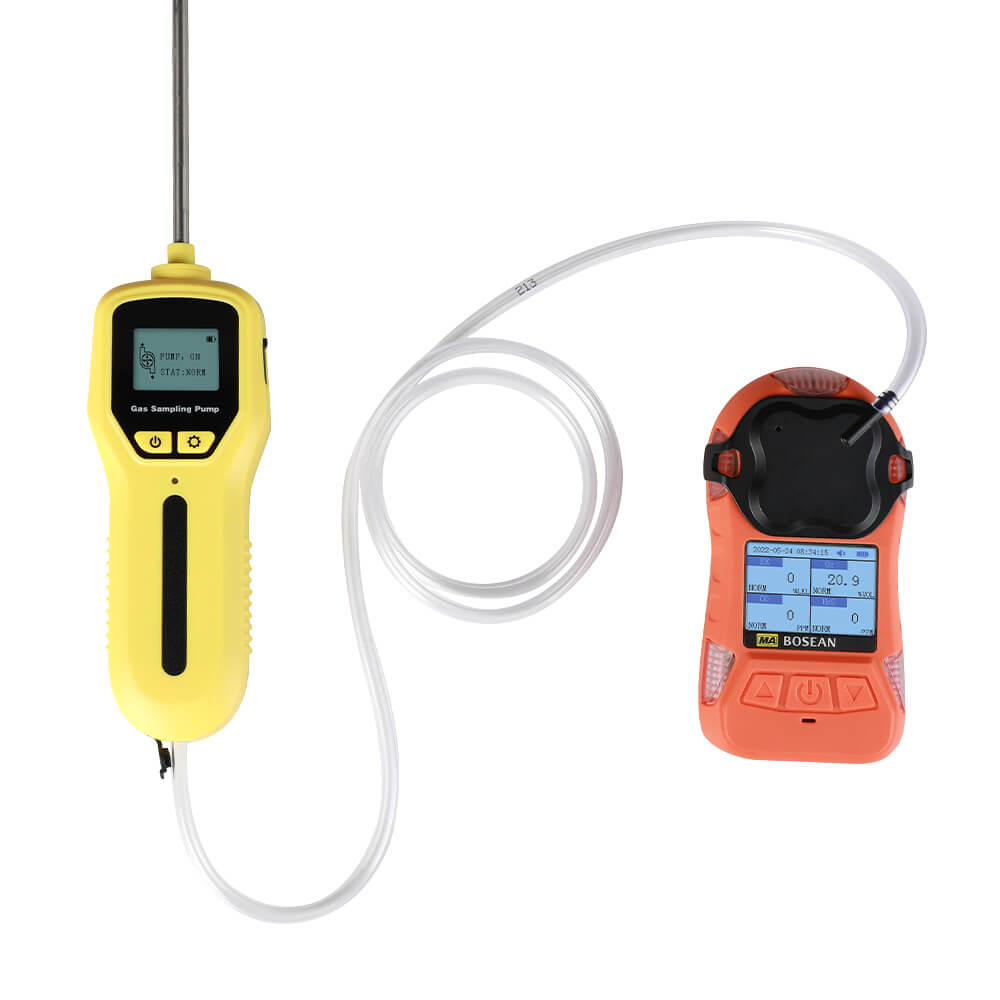
One sampling tube enters a portable gas detector, yet the screen can show several gas values in different units. The pump supplies a moving air sample, and each installed sensor measures its assigned gas or gas group. The number of channels reflects how many measurements the instrument can make from the sample delivered through that inlet.
Following the air through the instrument explains two features of a shared pump. All of the channels depend on delivery of a usable sample, while the units and response times belong to the individual measurements. The first question is when air from the current sampling point reaches the instrument.
What the Shared Pump Delivers
With the probe held away from the instrument, a length of tubing separates the air of interest from the sensing elements. The pump creates the flow that carries that air to the inlet of the portable gas detector. Until air from the probe arrives, displayed readings may still reflect air that was previously in the line.
One reason sharing the sampling hardware can make multi gas detectors portable is that each channel can use the same probe. A technician can carry one instrument and place one inlet at the location under observation. The tubing and any specified filter belong to the common delivery path, so their condition matters to every channel in use.
Once air arrives, the sensor configuration determines what can be measured. A channel fitted for oxygen produces an oxygen reading, while another sensor responds to the gas or gas group specified for that channel. A single inlet can support these separate measurements regardless of how a particular instrument routes gas between its internal sensing elements.
Why Readings Settle at Different Times
Oxygen reported as a volume percentage, carbon monoxide reported in parts per million, and combustible gas reported in %LEL can all describe the same sample. Their units follow the measurement assigned to each channel. A changing oxygen value and a changing combustible value can appear together without giving the same information about the air.
Six selectable flow settings on the Bosean K-600M cover 300–800 mL/min, and the instrument can read up to six configured gas channels at once. An integrated sampling pump is one way to keep multi gas detectors portable while giving the operator a choice of flow settings for an approved sampling arrangement.
Time in the sample line depends on the tubing dimensions and the actual flow through it. The line material must also be suitable for the target gas, and filter condition can affect delivery. Once new air reaches the instrument, the fitted sensors still need time to respond, so readings on the same screen can settle at different times.
At an actual flow of 300 mL/min, the pump would move a volume of air equal to the tube’s 150 mL internal volume in about 30 seconds. That calculation estimates transit through the tube alone. The interval needed for a measurement also depends on how the air mixes in the line and how each sensor responds.
Read a Pump Fault Separately From a Gas Alarm
If the pump fault warning appears on a portable gas detector, sample delivery needs attention even when the screen still shows gas values. A gas alarm refers to a reading on a configured channel. The pump fault warning on the Bosean K-600M concerns the shared sampling mechanism that the readings depend on.
Several readings can therefore be affected by one problem in the inlet path. Restricted flow through a tube or filter can delay air arriving from the probe, even when the sensors remain responsive. The installed line and filter are part of the sampling setup to be checked before readings from a new point are interpreted.
Numerical values and concentration curves offer different views of the same measurements. A K-600M record can be triggered by an alarm, captured at an interval, or saved manually to a TF card. After USB export, the record can be compared with the time a filter was changed or a probe moved to put the change in readings in context.
When a Separate Pump Serves the Same Purpose
An existing diffusion instrument can sometimes be used for pumped sampling if a compatible accessory is available. The Bosean ZC-600 is a separate self-priming diaphragm pump rated above 500 mL/min. Its arrangement delivers sample gas to a compatible instrument through a calibration cover fitted to that detector.
Keeping multi gas detectors portable with an external assembly involves carrying the detector and its sampling accessories as separate pieces. A built-in pump makes the instrument and its sampling mechanism a single unit. In either arrangement, the specified tubing, fittings, and operating conditions determine whether the instrument can receive a usable sample at the intended point.
A timing check belongs to the assembled equipment. If a crew changes from an integrated unit to an external pump with a calibration cover, the earlier estimate needs to be checked against the volume and flow of that setup. The readings can be interpreted together once the sample has arrived, the fitted sensors match the gases of interest, and the values have stabilized.
SEO Title: Portable Multi Gas Detectors: Shared Pump Sampling
Meta Description: See how a shared pump delivers samples to multiple sensors, why readings stabilize at different times and how a pump fault differs from a gas alarm.
