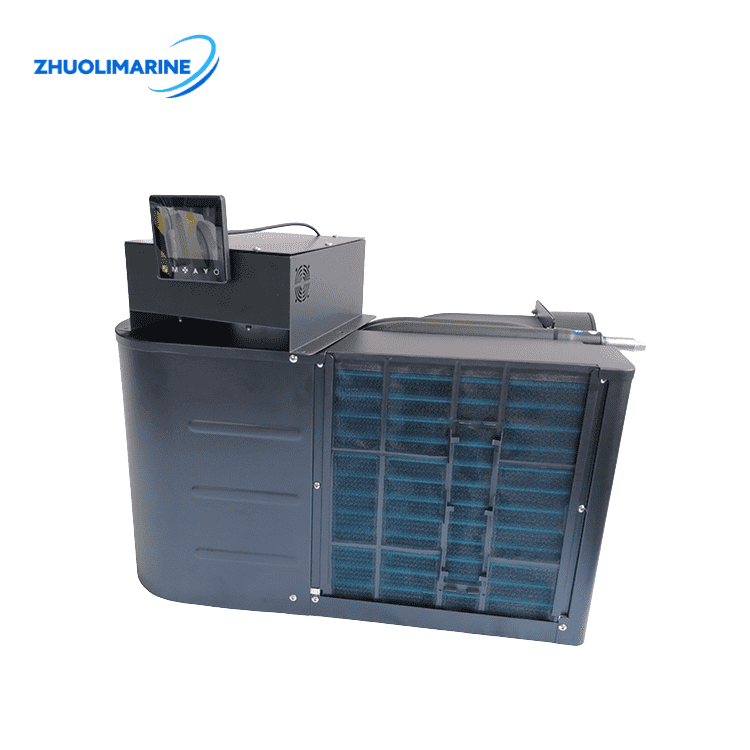
A locker beneath a cruising berth might already hold spare lines, tools and provisions, yet it may also be the only sensible location for a cooling unit. On compact boats, equipment rarely has a space of its own.
The decision to install air conditioning changes storage plans, electrical loading, plumbing routes and even how air moves around a sleeping cabin. Successful design therefore begins with the vessel’s actual layout, not with a cooling-capacity figure taken from a catalogue.
Start with the Cabin Rather Than Hull Length
Two boats of similar length can have remarkably different cooling needs. A narrow cabin with shaded ports loses and gains heat differently from a glazed saloon beneath a sunlit deck. Occupancy, cooking equipment, insulation and the frequency of hatch openings add further variations. A small boat air conditioning plan needs a room-by-room estimate of those loads before any equipment footprint is reserved.
Cooling capacity is commonly expressed in British thermal units per hour, or BTU/h. That figure describes the rate of heat removal, not the machine’s electricity consumption.
Oversizing a unit to compensate for uncertain measurements may lead to unnecessary cycling and uneven humidity control. A more defensible estimate considers the cabin volume, the local climate and the periods when the crew actually needs cooling. A cool ceiling does not necessarily mean that air is reaching the occupied berth.
Reserve Installation Space Beyond the Cabinet
Equipment dimensions alone cannot establish whether an installation will fit. Hose bends, electrical connections, intake access and clearance for replacing a filter require space outside the housing. Under-seat mounting may preserve visible floor area, but a hatch that opens only halfway can obstruct future service. The position also has to accommodate condensate management and an unobstructed return-air route.
The locker drawing can be tested against actual cabinet dimensions rather than an assumed small-unit outline. The MAR-12V/09BP measures 480 × 330 × 335 mm and weighs 20 kg net. The currently listed MAR-24V/12BP and MAR-48V/16BP each measure 590 × 345 × 345 mm, with net weights of 25 kg and 26 kg, respectively. Buyers should confirm any additional voltage and capacity combinations against the latest model specifications.
Their integrated configuration keeps the main refrigeration components in one enclosure, avoiding a separately positioned condensing assembly. The figures still need to be checked against the actual locker and service opening.
Make Two Circulation Paths Work Together
Cabin air and seawater perform different jobs in a marine cooling circuit. Air passes over the evaporator, returns to the occupied space and gradually lowers the room temperature. Water carries heat away from the condenser. Constricted air returns can weaken cabin circulation, while an inadequate seawater circuit can undermine heat rejection even when the compressor and controls are functioning.
Because a pump is chosen for the vessel rather than assumed from a nameplate, its operating point should be checked against hose lengths, fittings and restrictions. Return-air grilles must also stay clear once bedding and cruising supplies are loaded into the cabin.
The published specifications vary by model. The MAR-12V/09BP lists 500 m³/h airflow and 720 L/h seawater flow, while the MAR-24V/12BP specifies 600 m³/h and 1,080 L/h. The MAR-48V/16BP lists 650 m³/h airflow and 1,250 L/h seawater flow. Those values are useful when laying out ducts, grilles, pump selection and plumbing runs; they are not promises about the flow achievable in every vessel.
The basic marine package includes the air-conditioning unit and thermostat controller, whereas a seawater pump, filters, ducting or grilles may require separate sourcing. The resulting small boat air conditioning layout therefore involves more than locating a box beneath furniture.
Read the Electrical Ratings as Installation Constraints
A voltage label is an interface requirement, not a minor purchasing preference. Long DC cable runs and high currents require particular attention to conductor sizing, circuit protection and voltage drop. The current published model specifications show different electrical ratings. The MAR-12V/09BP is rated at 660 W and 55 A, with 720 W maximum input. The MAR-24V/12BP lists 1,020 W and 42.5 A, with 1,225 W maximum input, while the MAR-48V/16BP is rated at 1,130 W and 23.5 A, with 1,510 W maximum input.
ZhuoliMarine uses inverter control and electronic expansion-valve regulation in these DC models. Their specifications also list mobile-app adjustment through built-in Wi-Fi.
Variable-speed operation can respond to a changing cooling load, although actual energy use depends on conditions aboard. Electrical capacity, battery reserves and any charging source must be considered alongside the unit’s nameplate rather than inferred from its nominal BTU rating.
Keep Comfort, Corrosion and Maintenance in View
Sleeping comfort is affected by airflow direction, fan sound and the proximity of the machinery to the berth. Published noise figures vary by model. The MAR-12V/09BP and MAR-24V/12BP list 42/52 dB, while the MAR-48V/16BP specifies 42/55 dB(A). These figures provide comparison points rather than guarantees of identical sound levels after installation. Owners also need a workable path to the filter and seawater connections, since obstructed components are harder to inspect during a cruise.
A final small boat air conditioning check concerns marine exposure. These units have IPX4 protection at equipment level, while the centrifugal outer-rotor fan motor is described separately as IP68-rated; the two grades must not be treated as interchangeable. Stainless-steel housings with anticorrosion treatment address the damp environment, but sound ventilation, inspection and cleaning remain part of sensible ownership.
Final placement needs a drawing of service clearances, not just the cabinet; specifications for ZhuoliMarine’s compact self-contained cooling and heating units give that drawing concrete dimensions, with installation guidance, remote technical assistance and spare-part access available for follow-up. The installation drawing should show the air-return, seawater and electrical routes, with clearances checked against the selected model’s requirements.
