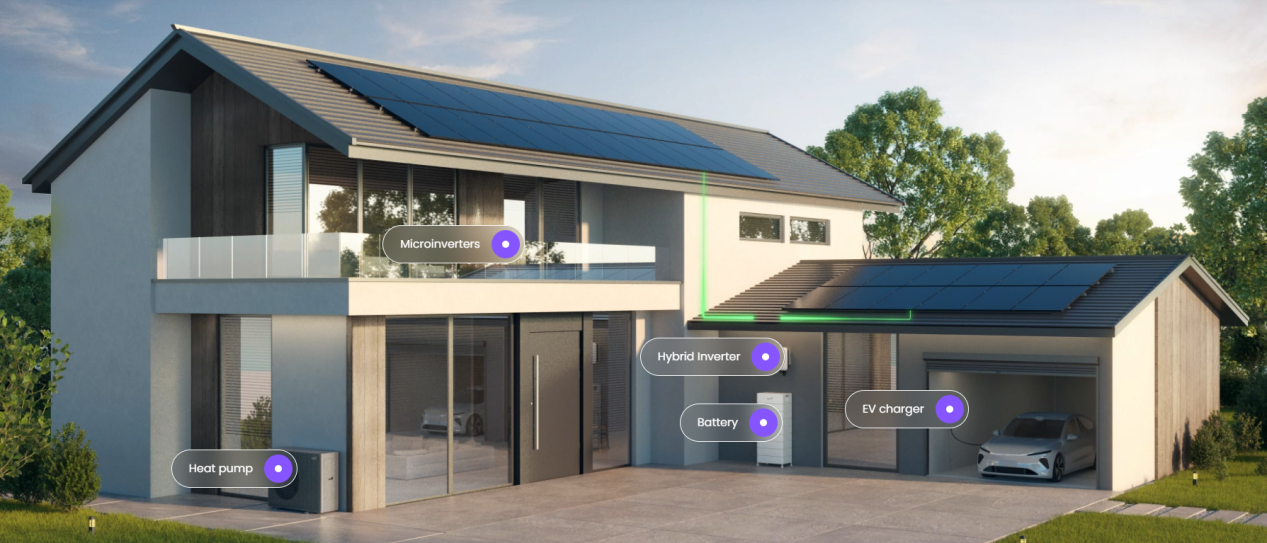
Choosing energy storage solutions involves more than selecting a battery with enough capacity. Homeowners and installers must consider how storage connects with solar generation, whether the system can expand, how efficiently electricity is converted, and how easily the equipment can be monitored.
Fox ESS addresses these requirements through a portfolio covering PV inverters, hybrid inverters, batteries, EV chargers, heat pumps, and digital energy management. Its market position adds another layer of evidence: S&P Global Energy ranked the company No. 1 globally in residential energy storage by MWh shipments for 2025.
A Complete Portfolio Changes the Storage Decision
A residential battery rarely operates independently. Solar electricity needs conversion before it can serve household loads or charge storage, while an EV or heat pump can become another significant electrical load. A supplier covering several parts of this chain can give installers more options when designing a complete home energy system.
Fox ESS offers PV and hybrid inverters alongside scalable batteries, EV chargers, and heat pumps. Its product portfolio also includes microinverters and C&I equipment, creating a broader technology base rather than a battery-only proposition.
When planning a solar system for a home, this width is an important consideration. Beginning with photovoltaics (PV) and storage, a project might subsequently include charging for electric vehicles or other electrified loads. That evolution is made easier with a broader ecosystem.
Scalability Keeps the System Aligned With Household Demand
Energy requirements can change after installation. A growing family, an EV purchase, or greater electrification can increase electricity consumption, potentially making an initially selected battery capacity less suitable several years later.
Fox ESS batteries are designed around modularity. The company describes its battery portfolio as high-performance and scalable, with modular designs intended to provide flexibility across storage applications. The product range includes multiple high-voltage battery families, allowing system capacity to be matched to different project requirements.
That approach gives installers more flexibility during system sizing. Instead of treating every home as having the same storage requirement, they can select a configuration based on the property’s current energy profile while considering future expansion where supported by the relevant product.
Scalability therefore becomes part of the system’s long-term value. It addresses not only how much energy a household needs today, but also whether the storage architecture can adapt as that requirement changes.
Inverter and Battery Performance Work as a System
Battery capacity alone does not determine how effectively a residential system handles solar electricity. The inverter provides a critical interface between PV generation, battery storage, household consumption, and the grid.
The hybrid inverter range is designed to work with the company’s high-voltage batteries. Several models emphasize high-voltage architecture, flexible configuration, plug-and-play installation, protection for outdoor deployment, and remote monitoring.
Product-level efficiency figures also demonstrate the engineering focus. The H3 Smart, for example, lists maximum efficiency of 97.9% and MPPT efficiency of 99.9%. These figures apply to the specified inverter and should not be confused with whole-system efficiency, but they provide useful component-level information for technical evaluation.
Such specifications become more meaningful when viewed alongside the compatible battery architecture. The result is a more coherent system design in which conversion and storage are selected to operate together.
Smart Control Makes Energy Storage More Usable
Physical equipment is only one side of modern residential energy management. Once a home has PV generation, storage, and multiple electrical loads, homeowners need visibility into how energy is moving through the system.
FoxCloud 2.0 provides remote monitoring through smartphone and web interfaces for compatible equipment. The company’s inverter documentation also identifies an AI assistant designed to help users understand and manage their systems.
This digital layer gives smart solar energy solutions a practical role beyond displaying production figures. Monitoring can help homeowners understand consumption patterns and system operation, while installers gain a remote view that can support ongoing system management.
The value is particularly relevant to households seeking greater control over their solar electricity. Instead of treating the battery as a passive appliance, users can interact with a connected energy system and gain clearer insight into how generation and storage are being used.
Market Adoption Adds Evidence Beyond the Datasheet
Technical specifications explain what equipment is designed to do, but market adoption provides a different form of evidence. A residential energy system must also prove commercially viable across installers, distributors, and homeowners.
S&P Global Energy’s 2025 Residential Energy Storage Market Tracker ranked Fox ESS No. 1 globally by MWh shipments and also placed the company first in Germany and the UK. The company reported that its global market share increased by 50% from 2024 to 2025.
More recent research provides additional context. A July 2026 white paper jointly released by Fox ESS and Frost & Sullivan reported that the global residential energy storage market reached 38.1 GWh in 2025 and ranked the company first by shipments with a reported 10.5% share.
Those figures do not replace technical evaluation, but they show that the product proposition has achieved substantial market adoption.
The Value Comes From How the Pieces Work Together
The strongest case for Fox ESS is therefore broader than any individual battery or inverter. Energy storage solutions become more compelling when capacity, power conversion, monitoring, and future expansion are considered as parts of one architecture.
Its portfolio provides scalable batteries and compatible hybrid inverters, while product-level specifications offer measurable efficiency benchmarks. Digital monitoring adds an operational layer, and the wider product range gives installers opportunities to connect solar, storage, EV charging, and other household energy technologies.
Homeowners might find the shift toward more interconnected solar energy options made easier with that combination. It broadens the product platform for distributors and installers, allowing for multiple home system designs.
Ultimately, the selection question is not simply whether one battery has an attractive specification. It is whether the supplier can provide a coherent system that performs efficiently, scales with demand, remains manageable after installation, and has demonstrated acceptance in the market. On those combined criteria, Fox ESS presents a well-rounded residential energy storage proposition.
