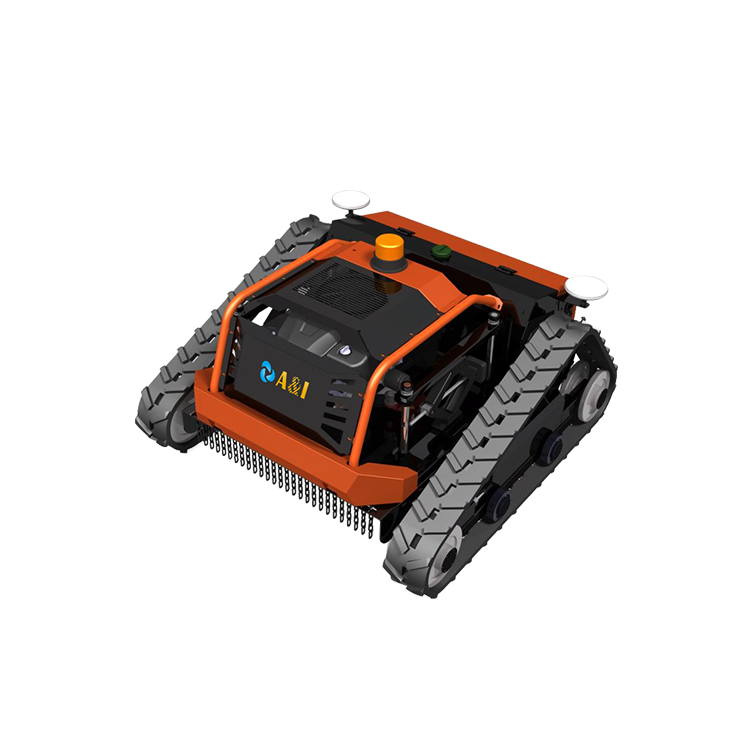
Not every mowing environment is suited to a conventional wheeled machine. Slopes, uneven ground, dense vegetation, orchards, roadside areas, and large agricultural sites can demand greater traction, maneuverability, and control.
The AWR27 is designed around these conditions, combining rubber tracks, a floating cutting system, hybrid power, and optional GNSS-based autonomous navigation.
For contractors, agricultural operators, municipalities, and equipment integrators, the better question is therefore where a tracked robot mower creates a practical advantage. The answer lies primarily in terrain, vegetation-management patterns, and the required level of operator involvement.
Why Terrain Determines the Right Application?
A tracked chassis changes how a machine approaches difficult ground. The AWR27 uses a rubber-tracked undercarriage with steel reinforcement and supports zero-radius turning, while its manufacturer specifies a maximum climbing ability of 50°. These characteristics make it particularly relevant to worksites where maneuverability and terrain capability are more important than road speed.
Its cutting system is equally relevant. A floating underslung deck is designed to follow ground contours, while the flail-blade configuration is intended for vegetation mowing rather than the highly uniform cutting typically associated with residential robotic lawn equipment. The documented cutting height ranges from 30 to 180 mm, with an 838 mm cutting width.
That combination points toward professional vegetation management. The machine is better considered as a robotic vegetation-clearing platform than simply as an automated lawn mower.
Agricultural Uses: Orchards, Vineyards, and Vegetation Clearing
Orchards and vineyards are particularly relevant because vegetation can grow between rows, around access areas, and across terrain that is not perfectly level. The AWR27 is specifically listed for orchard and vineyard weed control, as well as agricultural and forestry vegetation clearing.
An automatic weeding robot can be valuable in these environments when repetitive mowing or vegetation-clearing tasks occupy significant labor time. The AWR27 offers an autonomous-navigation option using GNSS, with support for straight lines, adaptive curves, custom paths, and geofencing.
Large and relatively regular agricultural areas are particularly suitable for autonomous operation. The manufacturer states that the intelligent navigation version is intended for unmanned work in large, regular areas, while the remote-control version is aimed at smaller or confined environments.
Agricultural operators can therefore distinguish between two operating patterns. Repetitive work across mapped areas can benefit from autonomous navigation, whereas irregular plots or tight spaces may justify direct remote control.
Landscaping and Infrastructure: Slopes, Roadsides, and Embankments
Professional landscaping extends well beyond flat lawns. Roadside vegetation, riverbanks, highway slopes, municipal landscapes, and rugged terrain can expose conventional equipment to challenging working conditions. The AWR27 is explicitly positioned for highway and roadside vegetation management, riverbank and embankment mowing, municipal landscape maintenance, and steep-slope mowing.
A tracked robot mower becomes especially relevant where maneuverability and ground capability influence productivity. Zero-radius turning can help the machine change direction within confined working areas, while the tracked undercarriage is intended to provide terrain capability.
Safety and operator positioning can also influence the choice of equipment. Remote operation enables an operator to control the machine from a stated distance of up to 200 m, according to the published specifications. An automatic weeding robot with optional autonomous navigation can further reduce the need for continuous manual steering when the site and operating plan are suitable.
These characteristics make the platform relevant to contractors maintaining vegetation in places where access, slopes, or repetitive mowing routes create operational difficulties.
Where Autonomous Navigation Adds the Most Value?
Autonomous navigation is not automatically the best choice for every worksite. Its value increases when the area is sufficiently open and regular for planned paths to be defined. The AWR27’s navigation option supports GNSS-based straight-line routes, adaptive curves, custom paths, and geofencing.
Such functionality can suit large orchards, agricultural plots, and extensive vegetation-management zones where operators would otherwise spend considerable time repeatedly guiding the machine along similar routes.
Smaller or highly constrained areas present a different requirement. Buildings, narrow passages, irregular boundaries, or other obstacles can make direct operator control more practical. The AWR27 therefore provides both an intelligent-navigation version and a remote-control configuration, allowing the operating method to correspond with site conditions.
For equipment developers, this dual operating concept can also be useful because autonomy does not have to mean eliminating manual intervention altogether. A machine can combine automated route execution with remote operation according to the task.
Matching the Machine to the Worksite
The most suitable application can be determined through a small set of practical questions. First, is the work primarily vegetation clearing rather than precision turf mowing? Second, does the site contain slopes, rough terrain, embankments, or other conditions where tracked mobility provides value? Third, is the working area large and sufficiently structured to benefit from predefined navigation paths?
Power and operating requirements also matter. The AWR27 uses a hybrid powertrain with a 27 hp, two-cylinder four-stroke engine, 48 V battery, and electric drive motors. Its stated mowing speeds are 3 and 4.2 km/h, with a maximum speed of 5.5 km/h and a working efficiency of 0.47 ha/h.
These specifications indicate a machine designed for sustained professional vegetation work rather than short-duration residential mowing. The appropriate deployment therefore depends on matching its terrain capability, cutting configuration, navigation mode, and working capacity to the site’s actual requirements.
Archimedes Innovation positions the AWR27 across agriculture, landscaping, infrastructure, and vegetation-clearing scenarios rather than limiting it to one type of property. For B2B buyers, that application breadth is useful when evaluating a platform for multiple contracts or seasonal tasks.
Ultimately, the strongest use cases are locations where vegetation must be cleared repeatedly and where terrain makes conventional mowing less convenient. Orchards, vineyards, roadside vegetation, riverbanks, municipal landscapes, steep slopes, and agricultural or forestry clearing all align with the documented application range.
Archimedes Innovation‘s combination of tracked mobility, floating cutting, remote control, and optional autonomous navigation makes the platform particularly relevant when professional vegetation management requires both terrain capability and flexible operation.
For contractors and agricultural operators, selecting the right configuration should begin with the worksite—not simply the label attached to the machine.
